Sunday, 20 November 2011

Butmas

Botmas is a small remote village in the back of beyond, up in the highlands of central Santo. The village has a church and a school and acts as a centre for the many isolated farms and families scattered in the thick tropical rainforest that covers the area. There has been no village aid post there for several years as the village health worker was never paid by the community for his services. The nearest clinic is about ten km away through difficult terrain; and by road transport at least 1000 vatu return (about £8), way outside the pocket of most people living here.
For these reasons, we at VFHA decided to pay them a visit, to give awareness on all health issues (especially reproductive health and STIs) and offer clinical advice and simple treatment as necessary.
Letters were written to the chief (nothing happens without his say-so) and copied to the pastor and sent by hand (most reliable method in the bush). Budgets were agreed, workshop details were planned, information leaflets photocopied, medicines prepared.
Transport proved to be a problem; few drivers were prepared to tackle the road unless they were paid huge sums to hire the truck as they felt they would be making an empty return journey (unlikely) and may miss out on a more lucrative “copra run”.
So we valiantly offered our little “truk” (Rav4) to do the journey, thus giving us flexibility in our planned trip and reducing the overall cost. Probably not our best decision....

We were at least an hour late in leaving, the road was rocky and potholed, then we turned off it to a “rod i no gud tumas” – small grassy/very stony track. At the top of a ridge, with beautiful views overlooking dense tropical rainforest in the lowering sunshine the fuse to the fan blew. As a result our radiator blew up.
Luckily as we were on a hill, we had mobile phone access (!) and contacted Raoul our mechanic who told us how to fix it and we limped on through the last 5k.
When we (eventually) arrived in Butmas village we were greeted with surprise and some embarrassment. We were not expected. The letters had arrived, but.....the Chief had gone to market in Luganville 2 days previously and he had not informed anyone of our intended visit.
However, Pastor Jacob and his wife Jeni made us welcome, as did the teacher and his wife, Suzanne. They offered us the (draughty) church as our sleeping quarters and the news that we would be holding a workshop the following day was relayed to the community via the football players who were just finishing their game.
Then we noticed we had a flat tyre........Christion (Community Educator) nobly helped change it for us.
That night it was colder than we had anticipated, especially as the walls of the church had great holes in them! We were glad of the extra blankets Jeni provided for us, and Christion slept inside a tent erected for him, inside the church. Worikar bedded down on a mat in one corner and we stuck six benches together as a bed and used our inflatable camping matresses. Washing in cold water was a challenge, Woreka insisted on hot water from the kitchen! Wise move. Rupert wore 3 shirts in bed that night and two pairs of socks. Our silk sheet bags from Vietnam helped keep us cosy. (Thanks MC and Mike!)


The following day we were asked if we would give a talk to the school children on healthy living. Woreka spoke to them about cleanliness and hand washing (worms!) and I gave a short talk on healthy diet.

The workshop was divided into 2 groups, men and women, about 30 participants in all. There was a lot of interest, many questions and we finished late. Next day as Woreka and Rupert held an informal clinic, Christion and I were able to talk to groups of people who wandered into the village as they had heard there might be a workshop going on.
 
This group photo has a delightful Victorian resonance about it. Here are the ample ladies clutching their certificates grouped in front of the Presbyterian church and Annie stands out as their mentor. One wonders what effect it will have.

 
We were anxious to leave before lunch as we were worried about getting home in one piece.
Luckily the truk held out. We arrived back without mishap and were relieved to hand it over to Raoule to fix it up whilst we went to Torba (Torres and Banks islands) for a couple of weeks..........

Saturday, 19 November 2011

West coast, Santo

I joined Julius, a VSO volunteer from Kenya and Jeffrey a NiVanuatu, both Laboratory technical officers for a 7 day trip up the isolated west coast of Santo to do health education around Sexually Transmitted Infection (STI) and HIV. We were joined by Joe, a HIV educator and Jean Marie the nurse from Tasiriki was to be our driver and mentor.
It was to be a 5am start and though we were all ready, the truck did not arrive till 05.55 as it had not been filled up with diesel and the pump did not open till 6am. There was also some story about a wake and some kava drinking well into the night.

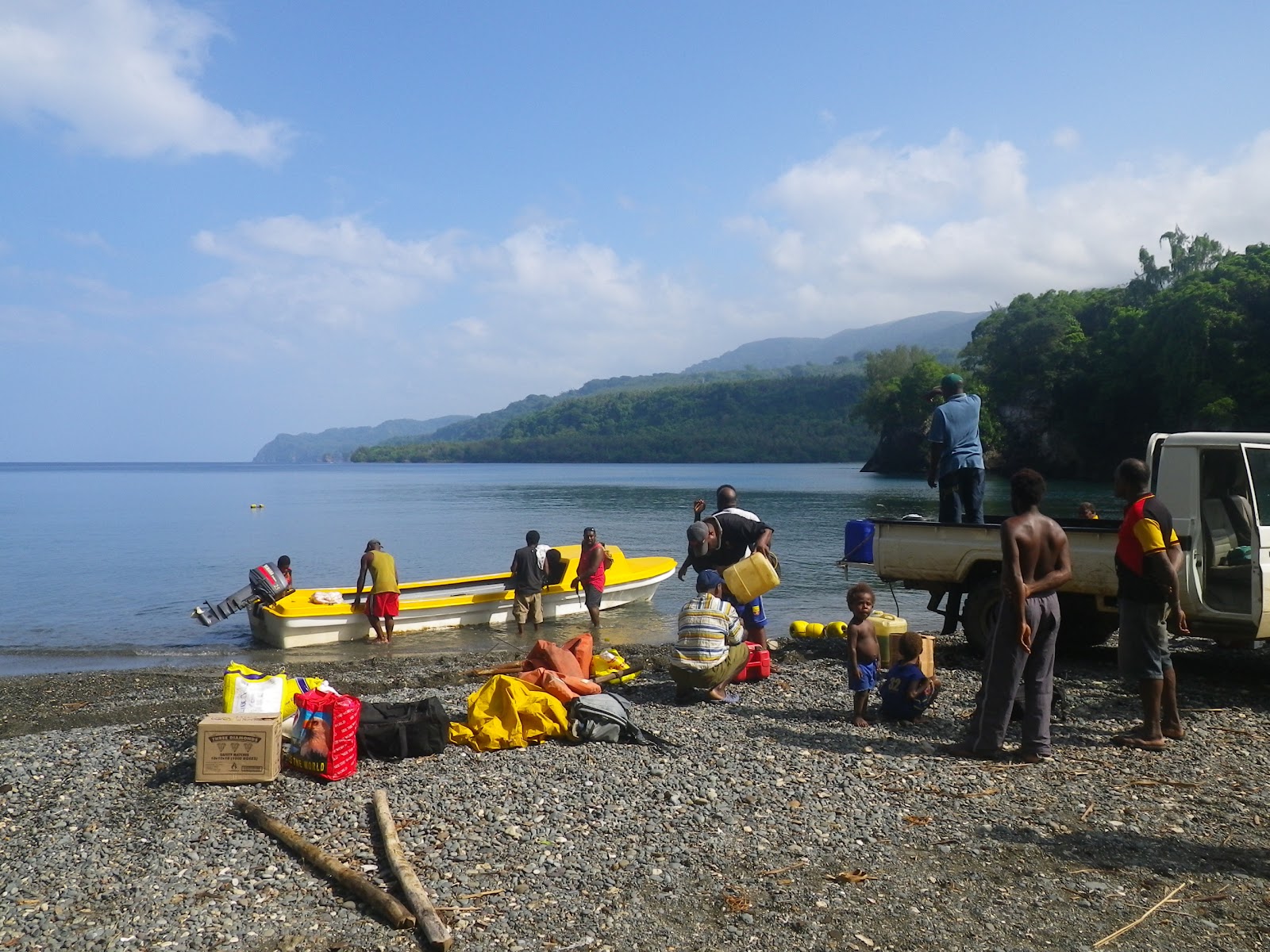
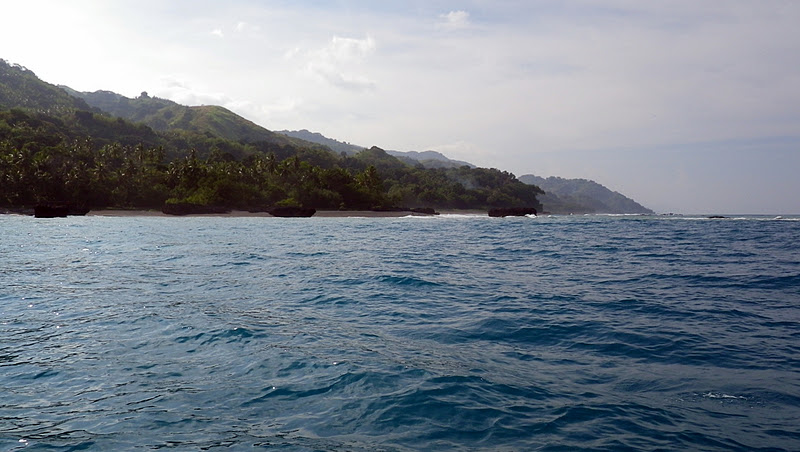
After a 2 hour road trip , fording several rivers where bridges had previously been washed away we reached Tasiriki at the south end of the West coast. Here we transshipped into a fibreglass boat and eventually at 9am started the 7 hour journey up the coast to Nokuku, about 60 miles away.
The communities are very isolated, no roads, no electricity, no mobile phone connection, irregular boats.


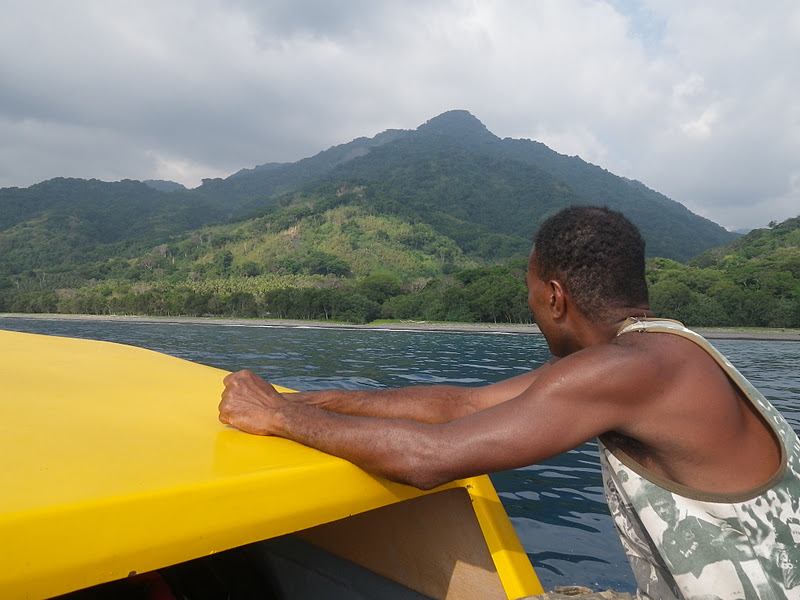
The sea was calm with a bit of a swell and we laid out lines for fish (caught a tuna and another smaller mackerel like fish) and delivered letters to various communities. This was done by backing up to the breaking surf and a young man leaping off with letter held high and jumping through the  rolling waves to hand it to some passing youth or pikinini l for further transmission. Meanwhile we admired the high peaks of the coastal range reaching up to 5000 feet and shrouded in cloud.

Nokuku clinic

Doing a tutorial on shoulder pain


Jeffrey taking a well deserved rest
My sleep mat and Julius's mat


Early morning and the banyan tree

Jean Marie grating coconut


Nokuku is a well organised community tucked under the mountains. We were given a great welcome and spent 3 nights there. The first day we had  12 custom healers or 'clevas' and we talked about their practice and we gave them as much information about HIV and STI as we could. Naturally they think they have appropriate treatment for jaundice, flu and syphilis sores since when you give the treatment the problem goes away as is the natural history of the disease, as doctors did in the 19th century with cupping and injections of mercury or whatever. The clinics are set every 20 miles so it is no wonder people seek out the help of their 'clevas' round the corner.
Julius lecturing
The 'clevas'
Julius under the banyan tree


 They were a reflective group with lots of experience of illness. In a different world a lot of these 'clevas' would become nurses or aid post workers. I spent some time talking about back ache, referred pain, sciatica and sore knees which they were very interested in. I think it may have improved their diagnostic skills.

Next day we had community education which was very well received with many questions.
Eventually on the last day we had a great feast and a splendid send off with sulu sulu round the neck and  presents.


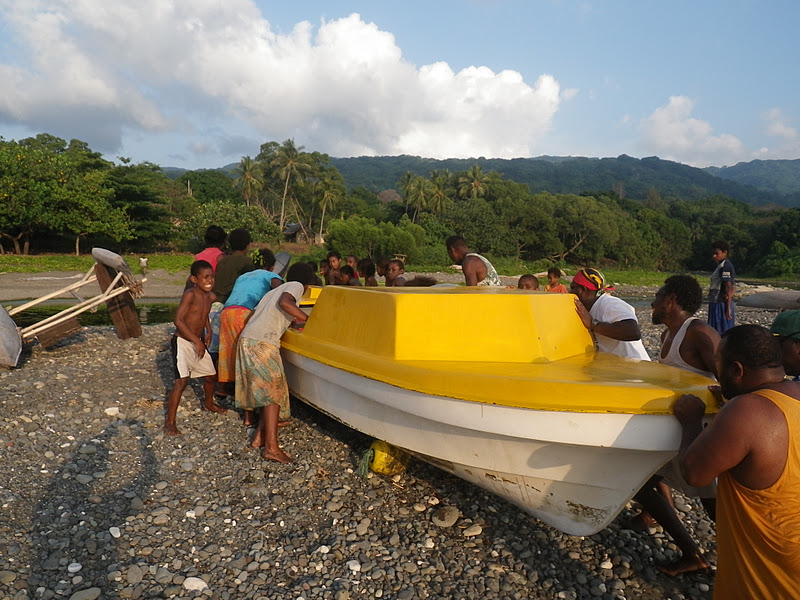
Next stop was Wunpuko another 25 miles on just beneath the northern tip of Santo. Crowds of school children helped us pull the boat high up on the shingle.


After settling into the guest house we went for an evening swim in the river which was delightfully refreshing. The men always 'swim' upriver of the women to avoid 'downhill pollution'.

Next day we had another full day on community education with some good audience participation like questions 'Why do men always want sex?' It was only after we had left that one of our group talked about the possible sex workers there (whether that was from personal experience I never found out).

I visited the clinic which is staffed by Nettie. Thirty years ago she had been a second year nursing student and her new husband took her away from nursing school. She practised as a traditional midwife and now in her fifties she went back to train as a nurse aid. Her clinic was spotless (alas forget to get her photo!)

Now after an early 6 am start we had a further 5 hours trip back half way down the coast to Tasmate (with a short break at Nokuku to pick up a brother, a cousin and mangoes and taro).
Beautiful banyan tree of Tasmate
Shower under the banyan tree


Nurse Meriame is new and has spring cleaned her clinic


Why bother to go to yet another 'workshop'


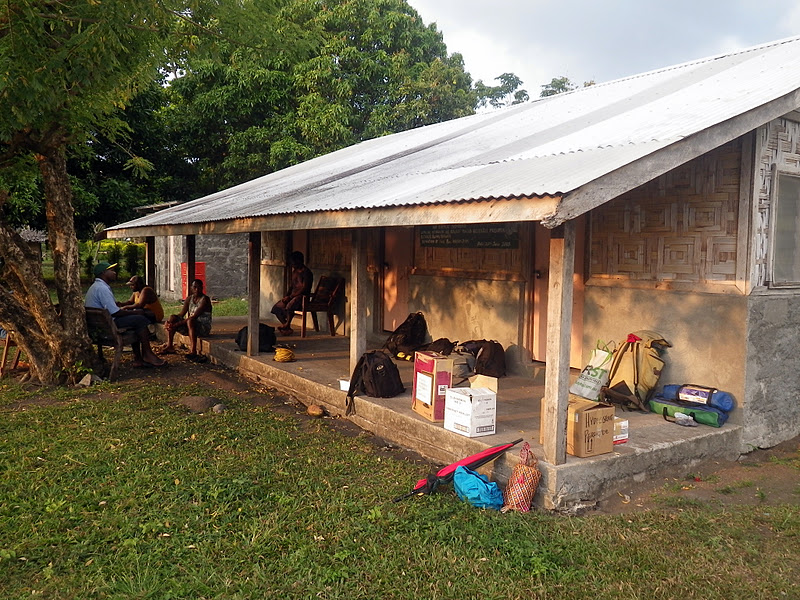
Last night in the nurse's house in a very comfortable bed with a running water shower and flush toilet. A half day community education next morning completed the tasks so we left that afternoon for Tasiriki arriving 4 hours later to be met by the Provincial health manager who packed us into the truck getting us back to Luganville by 7pm.

All in all a good trip, much achieved, I managed to spend a half day at each clinic doing supervision and learnt a lot from Jeffrey. Julius was very brave since he is a country Kenyan from near Kisumu and had not been to sea much. I spent quite a lot of the journey talking him through different wave forms and when to remain calm and when to react to a boat about to capsize. (We came close to be caught broadside in a breaking wave on to the shore but were saved by Jean Marie who leapt into the sea and by brute force turned the boat head into the waves). 200 litres of petrol  together with touring allowances for 3 staff meant the trip  probably cost about £1000. It is very expensive to access and provide health care to these isolated communities.