Sunday, 15 May 2011

Pacific Partnership part2


This is what greeted me on Saturday morning; he was spraying pesticide but looked fairly awesome.
The team set up trestle tables to do initial assessment of problem, weight and blood pressure and olgeta gathered. They took over all the consulting rooms and had between 8-12 physicians consulting.
Those needing the dentist or had eye problems were sent off to other areas. Meanwhile about 300 people gathered to be seen.

The PP medical team wandered about in fatigues and it was difficult to tell who was the faciomaxillary surgeon from Otago, a trauma nurse, a corpman (very competant nurse auxillary) or a reservist fireman from Ohio. They felt the same, as the nurses here generally do not wear uniform and the Emergency room had a gathering of Nivanuatu with nothing to distinguish sister in charge from the patient's relative.
The Nivanuatu were very patient and came with their chronic coughs, backaches and knee pain. There was a general expecation that something could be done to help them.


Dr Bruce Greig, a Sydney GP, was in charge of the team and managed to keep smiling. He does this once a year to make a change from suburbia. Veronica was the senior  US nurse who organised everyone extremely well and managed a smile.
Over the next 4 days there were about 500-600 people seen a day.
I saw one of my TB patients queueing up to get his ears checked. Defaulting diabetic patients were told they had to lose weight and go back to the diabetic clinic! Patients with  high blood pressure were told that they had to restart their tablets.

Dr Noa Hammer and Dr Torrin Velazquez had excellent consultation skills and were a pleasure to watch. They were very ably helped by interpreters from the USP (University)  or by some Nurse Practitioners who were by the end giving health education without needing to be told!


Nwarikar and Annie have a visit from Big Jimmy and his team
At the end of the day they gather to go back to their ships. Meanwhile Annie has been doing a lot of networking.

 The eye team and the dentists did fantastic work with over 1000 extractions and lots of glasses organised. The medical team had lots of chronic problems and I am not sure 'how much value was added' to what is usually provided here.
It is worth pondering what would happen if free medical/dental/eye checks were offered in Chicago/Melbourne/Wellington/Liverpool and who would turn up with what problems.


Saturday, 14 May 2011

Pacific Partnership part1

USS Cleveland
HMNZ Canterbury
HMAS ?Balikpapan
  
The Pacific Partnership is a joint mission ' to build and strengthen alliances, partnerships and relationships...' and to counter the growing influence of the Chinese. The United States, New Zealand and Australia are providing a 4 months joint mission with 2 weeks in each of Tonga, then Santo in Vanuatu then Papua New Guinea, East Timor and finally Micronesia. There is a 150 person Medical team, about 90 Engineers and many other logistic people.
 The youth in NCYC were asked to produce banners which looked great on the day of the arrival ceremony.
They chose to do the flags.

 The Captain of the fleet, Capt Jessie Wilson was welcomed by a group of NiVanuatu in custom dress chanting their local songs.
Many dignitaries arrived including the American Ambassador, the New Zealand and Australian High Commissioners and there seemed to be about as many on the stage as in the audience.
 Capt Jessie gave an excellent speech and reminded that the Americans had in 1942built the present day Luganville where there had been swamp and also the water supply to the town which still provides top quality water. Just before he had been involved in the clubbing of a pig but lucky for him he had only to lay a symbolic club on the head and the Chairman of the Council did the bone crunching deed.
The Navy band played and everyone had a good time. Dr Fred Merchant gave a happy smile (he is a locum surgeon provided by AusAid and doing great work - thank you AusAid) and the military photographers recorded everything for their publications.
Dr Fred


Next day, Saturday, there was a full day conference for health workers. The subjects chosen by the Nivanuatu were Diabetes, Breast cancer and Sexually transmitted infection. They made excellent presentations and really impressed their American audience by how much they knew and what they were already doing.
Adeline, the nurse practitoner Diabetes specialist


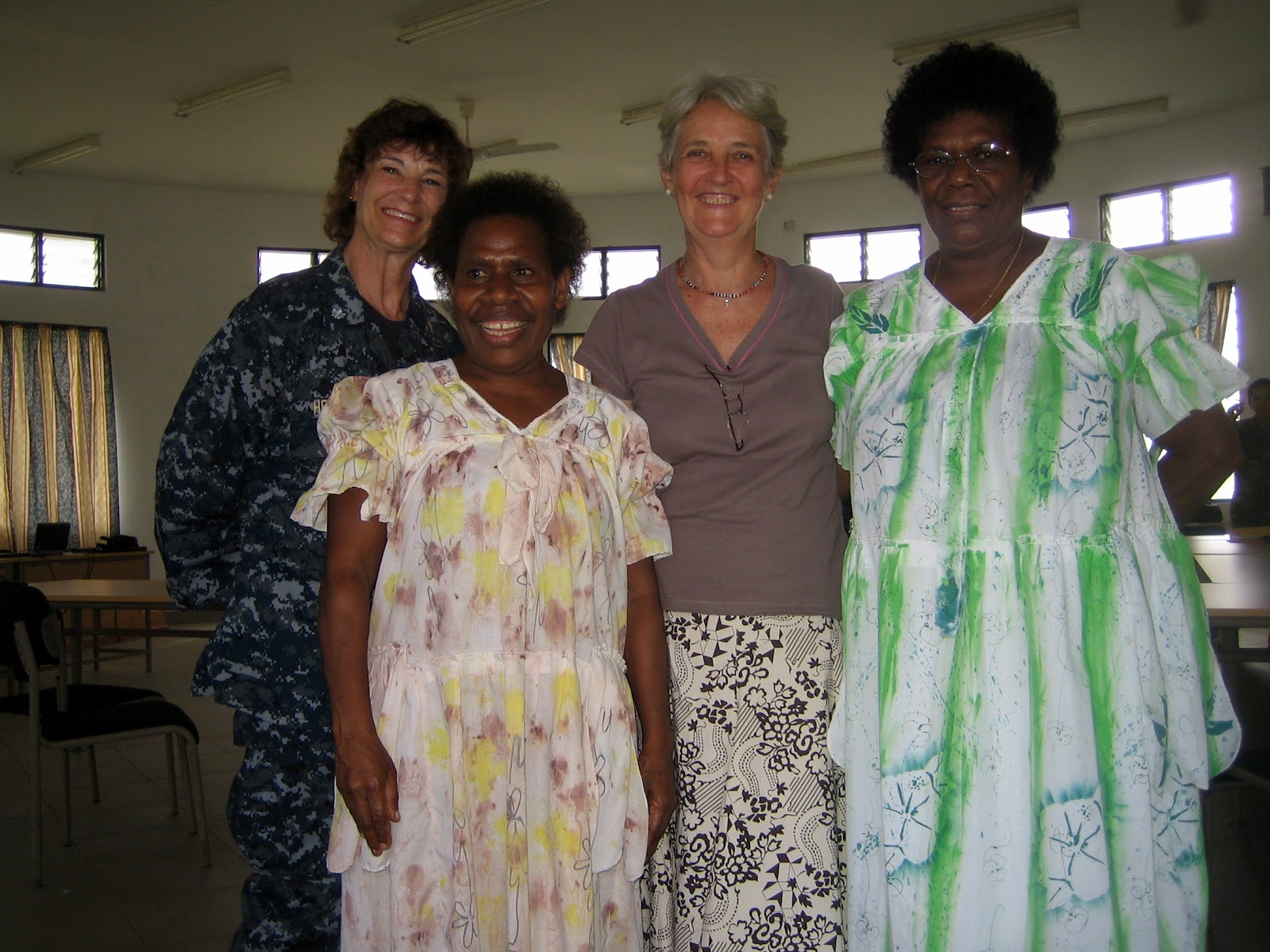
Nwarikar gives her excellent presentation with Annie helping with the Powerpoint. She was so pleased afterwards and here is posing for the. photographer


Annie with her team of Nwarikar and Lemeiko
Recording the action for future publication

Monday, 2 May 2011

Easter Weekend

Two years ago we had a memorable Easter weekend with Sandra, Sara, Stefan and Edel on the shores of Lake Victoria and this year we spent the weekend with two other VSO Volunteers Lucy and Jackie on the east coast of Santo.
Lucy is a sexual health nurse who is working in the Torres and Banks Islands in the north. It is challenging what with the rats eating into everyone of her 12 cartons of milk we sent her and into her food cage, the apparent lack of vegetables especially as she is a vegetarian and the large amount of travelling she has to do in small open boats with outboard motors. Fortunately vegetables are now coming in since she put the word out.
Jackie is working in Governance with the local Councils in Port Vila and which council wants anyone looking over their shoulder. So finding it challenging to engage and wondering how long it takes to be accepted.

So off we went up the East Coast road recently built by the Americans with the help of the New Zealanders to Lonnoc beach resort.
The views are lovely, the beach front delightful and a lovely place to relax. Food was somewhat basic with an especially requested vegetarian option producing an omelette with a very runny centre that needing reheating.


Richard Lo a Vanuatu /Chinese /Australian owns the best supermarket in town and runs several other businesses. His daughter Isobel was marrying an Australian Ryan Gerathy and they were taking over the resort for the next night.

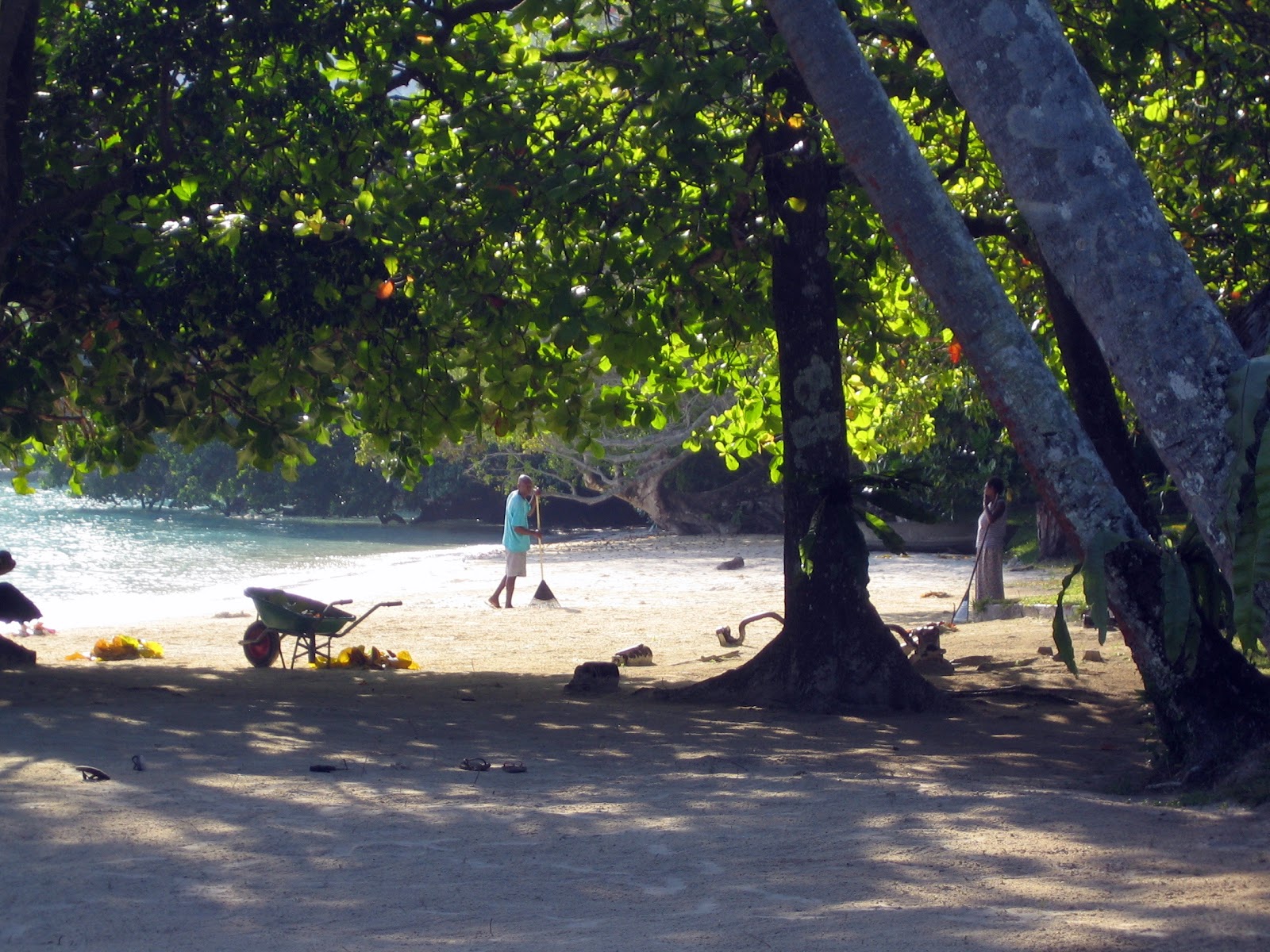
So next morning we had to move out but were able to witness the preparations as food was prepared, flowers arranged and garden swept. Cooks were bought in from the South of the island and lorries arrived with booze or flowers or food. We heard it was a great success.


We stopped at Oyster Island for a snorkel over beautiful plate coral and then an hours paddle in a canoe up the river to a 'blue hole'. This is where an underground river comes to the surface and forms a pond about 50 metres across with an intensely bright blue colour. Next day we went out to million dollar point  ( see previous blog) and had our Easter day picnic. Later it was home to a cup of tea and a patisserie from the French Restaurant.
That evening we went to Le Jardin de Saveur. We had warned the chef about two vegetarians and he had said 'No worries, we will see what we have in that day!'. We were a bit anxious but he produced an excellent spread of about six different vegetables cooked in different ways with different flavours and Annie and I half wished we had made that order. The creme brulee that followed was something that memories are made of.
Next day there was a VSO gathering and here is the evening in the Chinese Restaurant after a hard days work. Clockwise from Annie is Helen (Uganda) Sexual health on Malekula, Marty (Phillipines) Governance in council on Santo, Lucy (UK) Sexual health Banks islands, Colenso (Nivanuatu) her partner, Nwarikar Annie's partner at Vanuatu Family health, Jenita (Nivanuatu) VSO in Vila, Lemarco Annie's partner in NCYC, Neil (UK) IT in local council, Whelma (Phillipines) VSO Country director but started life as VSO volunteer in Iringa in Tanzania  and Julius (Kenya) Laboratory specialist. Missing is Eric (Kenya) Sexual health on Ambae who could not come as they cancelled the flight and next flight is Friday.

Million dollar point

F


Excerpt from Cabinet by Sasha Archibald 
see www.cabinetmagazine.org/issues/10/million_point.php 

At the end of the war, sometime between August 1945 and December 1947, the US military interred supplies, equipment, and vehicles under water. The travel writer Thurston Clarke describes the scene:
The Seabees built a ramp running into the sea and every day Americans drove trucks, jeeps, ambulances, bulldozers, and tractors into the channel, locking the wheels and jumping free at the last second. Engine blocks cracked and hissed. Some Seabees wept. Ni-Vanuatu witnessing the destruction of wealth their island would never see again, at least in their lifetimes, thought the Americans had gone mad.1 

Million dollar point is about 10 minutes down the road and is the site of a massive water front dumping ground from the US forces after the Second World War. It is not clear what the circumstances were but the article above by Sacha Archibald has plenty of information and is worth reading if you want to know more.


It is fascinating seeing huge blocks of material, pipes, girders, coils, wheels and roofing stuck together and now being colonised by the coral. The picture above shows one coral plate draped over the metal frame like a table cloth.
In some places the coral growth after 65 years has been so strong that it is smothering the material.
Sometimes it is possible to see a motor or bulldozer track and sometimes it is just impossible to determine the origin. Some seem to sheets of roofing as for the Quonset hut now welded together
There are fish swimming about amongst the coral picking at bits and pieces which adds to the delight.


Publish Post


A mermaid explores


A bulldozer hovers upside down over the abyss and now is stuck fast.
Below various wagons, fork lift trucks and other motors appear out of the depths.
It is possible to see all these things snorkelling from the surface. At low tide one can stand on much of the debris and just look at the coral and fish through the goggles


                                                                                                                   A ship about 50 foot long seems to have been beached and is in significant decay. The coral has made a lovely display on the railings.